
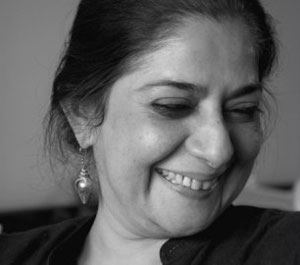
Sheba Chhachhi, an installation artist, photographer, activist, and writer based in New Delhi, India, was on campus for the month of February 2005 in a visit organized by the Women’s Studies Department and funded by the Townsend Residency Program.
Born in 1958 in Ethiopia, Chhachhi was educated in Delhi, Calcutta, and Ahmedabad, India. In 1980, she began to do documentary photography, building up a body of work on the women’s movement in India. A decade later, questions about the politics of representation led her to experiment with alternative photographic practice, and she created a series of constructed portraits in collaboration with women activists.
Chhachhi began to work with multimedia installations in 1993, using photographs, text, sculpture, and found objects to investigate and articulate the history, experience, and power of feminine consciousness. Her recent work synthesizes video, sound, and light with more physical materials. Chhachhi has worked with varied media in galleries, women’s groups (both rural and urban), educational institutions, and museums. Her work has been shown in India, the U.K., Canada, China, Japan, France, Germany, Cuba, and the U.S.
At this workshop, Chhachhi discussed the slippage between the unmediated “truth” of testimony and the highly mediated statements made by artists around the same experience.
Chhachhi examined dominant media representations which construct reductionist perceptions of the conflict in Kashmir.
Townsend Center
Created in collaboration with women renunciates and ecstatics in various parts of India, the photographs seek to share the unusual lives of contemporary women sadhus—from the almost naked beatific to the power-dressing female mahant.
Department of Architecture
This work relocates the mythological figure of Neelkanth, in the contemporary Indian city, where each of the five elements (earth, fire, water, air, and ether), the five senses (smell, sight, taste, touch, and hearing), and the power of the word itself is poisoned. The exhibit asks if we, like the archetypal Neelkanth, can find means of containment and transformation, can we make nectar from poison?
Department of Art Practice Exhibit Room
This photo installation by Chhachhi and Sonia Jabbar invites viewers to enter the private life of war, to hear voices often obscured by the clamor of stereotypes—the unheard voices of ordinary women of the Kashmir Valley. Testimonies gathered over six years break through the homogenizing divide of “Muslims” versus “Hindus.” Despite many differences, the women have one overwhelming thing in common: a rejection of the gun as a solution to political issues.
In addition to the Townsend Center and the Department of Women’s Studies, co-sponsors of Chhachhi’s visit included the Departments of Architecture, Art Practice, South and Southeast Asian Studies, Sociology, Anthropology, Rhetoric, and Political Science; International and Area Studies; the Peace and Conflict Studies Program; the Center for South Asia Studies; the Beatrice Bain Research Group; the Center for Race and Gender; and the UC Santa Cruz Women’s Studies Department.
Resident Fellows
Patricia Barber
Charles Burnett
Sheba Chhachhi
Didik Hadiprayitno
Gareth Stedman Jones
Sunil Kumar
Daniel Mason
Ray Müller
Suman Mukherjee
Pedro Antonio Valdez