
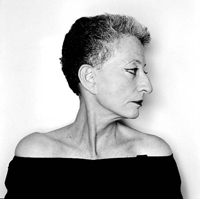
Webcast || Hélène Cixous was born and raised in Algeria to a German Ashkenazi mother and Algerian Sephardic father. Her dissertation work was in English literature, studying the work of James Joyce, which was subsequently revised and published in 1968 as James Joyce ou l'art de replacement (The Exile of James Joyce). The following year she published Dedans (Inside), a semi-autobiographical novel, her first, that won the Prix Médici. She is a professor at the University of Paris-VIII, which she helped to found, and whose center for women’s studies, the first in Europe, she founded. She has published widely, including 40 works of fiction, 10 books of essays, 12 plays, and numerous influential articles. Along with Julia Kristeva, Cixous is one of the best-known of the late-20th-century “French feminists.” She published Voiles (Veils) with Jacques Derrida and her work is often considered deconstructive. In introducing her Wellek Lecture, subsequently published as Three Steps on the Ladder of Writing, Derrida referred to her as the greatest living writer in his language. Recently, Cixous has been writing on Derrida, including a 2001 study titled Portrait de Jacques Derrida en jeune juif (Portrait of Jacques Derrida as a Young Jewish Saint). In addition to studies of Derrida and Joyce, she has written monographs on the work of the Brazilian writer Clarice Lispector, Maurice Blanchot, Franz Kafka, Heinrich von Kleist, Michel de Montaigne, Ingeborg Bachmann, Thomas Berhard, and the Russian poet Maria Tsvetayeva.
Research and teaching have brought Cixous to universities and libraries in several countries, in recent years especially to the United States and Canada, where she has lectured frequently, has taught many times as a visiting professor, and has received several honorary doctorates. Her California visits include research in 1963 for her secondary thesis on Robinson Jeffers, the 1990 Wellek lectures at the University of California at Irvine, a 1998 Stanford Presidential Lecture, and a 2002 keynote address for a conference in her honor at UCLA.
Cixous is known for her experimental writing that crosses the traditional limits of academic discourse into poetic language. She is admired for her role as an influential theorist, and also as a novelist, a playwright, and an educational innovator. In the United States she is primarily recognized for developing “écriture feminine,” a method of dealing with subjective difference in writing and social theory, and overcoming the limits of Western logocentrism. Écriture feminine is a practice that addresses Cixous’ ongoing concern with the effects of difference, exclusion, and the struggle for identity. In 1975 Cixous published the essay Le rire de la Méduse (The Laugh of the Medusa), in which she describes how women might write, breaking from myth and rhetoric that have kept them from participating in the public sphere. This is a key text among many that work with her influential concept of “écriture feminine” and the transformation of subjectivity.
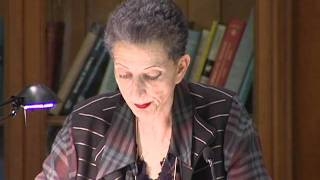
Follow-up Panel Discussants: Cixous, Pheng Cheah (Department of Rhetoric), Suzanne Guerlac (Department of French), and Judith Butler (Departments of Rhetoric and Comparative Literature).
Una’s Lecturers
Nicholson Baker
Hélène Cixous
J.M. Coetzee
Wendy Ewald
Anthony Grafton
Greil Marcus
Eva Hoffman
Robert Post
Mary Louise Pratt
Frederick Wiseman