
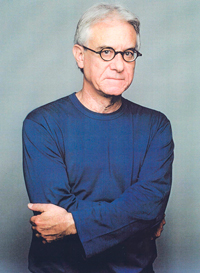
Greil Marcus was born in San Francisco in 1945 and grew up in the Bay Area. He earned his undergraduate and graduate degrees in the late 1960s from the UC Berkeley in American Studies and Political Science, respectively. In 1969, he began a career-long relationship with Rolling Stone, becoming the magazine’s first record review editor. He served as the book columnist from 1975 to 1980 and is currently a contributing editor.
In 1975, Marcus released his first book, Mystery Train: Images of America in Rock ‘n’ Roll Music, which is widely regarded as one of the finest and most scholarly studies ever published about Rock ‘N’ Roll. A distinctive feature of Marcus’s writing is his ability to connect Rock ‘N’ Roll to political and social history. “A critic’s job,” Marcus explains “is not only to define the context of an artist’s work but to expand that context.” The book, which was nominated for the National Book Critics Circle Award for Criticism, received rave reviews. The New York Times called Mystery Train “a classic… full of passion and intellectual fervor,” while The Washington Post called the book “a remarkable study of ‘the very idea of America: complicated, dangerous, and extreme.’”
After the release of Mystery Train, Marcus continued writing book and music columns for magazines while embarking on a nine-year stint researching and writing his next book, Lipstick Traces: A Secret History of the Twentieth Century (1989). Unlike Mystery Train, which focused exclusively on the influence and context of American artists from bluesman Robert Johnson to Elvis Presley, Lipstick Traces is about European and English movements, ideas, and artists. In the book, “Marcus proposes a genealogy of anarchistic naysayings from the Dadaists to the [French] Situationist International to the Sex Pistols,” observed Interview magazine.
Over the past decade, Marcus has continued to write about music and popular culture for Artforum, Interview, the New York Times, Esquire, Salon.com, and other publications. He has taught American Studies seminars at UC Berkeley, Princeton, and the New School University and has lectured throughout the United States and Europe. He has also served on the Board of Directors of the National Book Critics Circle Award (1983-1989).
About the Lecture: "Somebody has to black hisself / For somebody else to stay white." So wrote Melvin B. Tolson in the 1930s in A Gallery of Harlem Portraits. Though we may think of blackface performance as a relic of the past ("I saw one of the last blackface minstrel shows," Bob Dylan writes of his boyhood in Hibbing, Minnesota, in the early fifties), cultural critic Greil Marcus will take up the persistence of blackface in contemporary culture, as bad conscience, yearning dream, and indecipherable joke.
Follow-up Panel Discussants:
Shannon Steen (Theater, Dance and Performance Studies) and Bryan Wagner (English)
Moderator: Anthony J. Cascardi, Director of the Townsend Center for the Humanities
Official Homepage
Wikipedia Entry
Video: Interview on The Alcove with Mark Molaro (18 December 2007)
Video: Authors@Google series (23 August 2007)
"The American Dream," UC Berkeley commencement address 2006 (published on Salon.com, 4 July 2006)
"Stories of a Bad Song" (Threepenny Review, Winter 2006)
"Greil Marcus on Recording 'Like a Rolling Stone'" (NPR.org, 11 April 2005)
"Sometimes He Talks Crazy, Crazy Like a Song" (Review for the New York Times, 2 September 2001)
"All These Inches Away From Where Greil Marcus Began" (interview at Powell's Books, 4 April 2001)
Una’s Lecturers
Nicholson Baker
Hélène Cixous
J.M. Coetzee
Wendy Ewald
Anthony Grafton
Greil Marcus
Eva Hoffman
Robert Post
Mary Louise Pratt
Frederick Wiseman